Thursday, 14 June 2012

Philadelphia Orchestra, London’s Philharmonia and the MontrĂ©al Symphony…all in less than two months

It’s been a busy couple of months for concert-going. I was fortunate enough to visit six different concert halls in five cities to sample performances by some of the world’s finest musicians.

During a stop in London on April 24th, I saw Leif Segerstam conduct the Philharmonia Orchestra and pianist Denis Matsuev in London’s Royal Festival Hall.  I found Segerstam a bit of a plodder, in a programme of works by Sibelius, Rachmaninov and Tchaikovsky – “respectful, subtle and down-to-earth”, as I said in my review for Bachtrack.

It was my first real stop in Philadelphia, Pennsylvania at the end of April, and was delighted it coincided with the city’s eponymous orchestra performing in the Kimmel Center for the Performing Arts under Sir Simon Rattle.  I was keen to find out how Maestro Rattle would fare with an American orchestra going through Chapter 11, having swept the world off its feet with the Berlin Philharmonic.  In a programme of Brahms, Webern and Schumann, he gave me some interesting insights into works which shared similar origins but took different paths of development. 
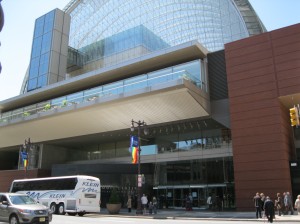
The Kimmel Center for Performing Arts, Philadelphia

In October 2010, I saw Alan Gilbert, the New York Philharmonic’s dynamic Music Director, in Mahler’s Sixth Symphony.  My heart goes out to him, as he must feel the breath of Mahler down his neck, the famous composer having been his predecessor as conductor of the orchestra a century ago.  The performance in the Carnegie Hall on May 2nd was impressive enough, and a reviewer taking copious notes in the next seat remarked that the concert was “pretty good”, but I preferred what I heard some one and a half years previously.

For many years, the Salle Wilfrid-Pelletier, part of the Place des Arts complex in the heart of Montréal, was home to the city’s world-famous orchestra (Orchestre Symphonique de Montréal – OSM).  Having steadied itself under Maestro Kent Nagano after reeling from a few years of turmoil with the departure of Charles Dutoit, who brought OSM international recognition, the orchestra seems to have picked up the pieces and pulled itself together.

I was lucky to get into the OSM’s concert at the end of May featuring Ravel’s Daphnis and Chloé, not often performed as a symphonic work in its entirety.  For a change, I sat in the balcony this time in the orchestra’s new home, La Maison Symphonique de Montréal.  I was never a fan of Salle Wilfrid-Pelletier, where at one point I heard only muffled sound under the balcony covering half of the lower level of the hall; I was equally unimpressed by La Maison.  With a large number of wooden surfaces, it sounded too much like an echo chamber.

I had it on good authority that Kent Nagano had just returned on the morning of the concert with the OSM from Munich, where he had been working on the première of Wagner’s Ring Cycle by the Bavarian State Opera.   He showed no sign of fatigue as he raced his way through a fine programme of Berlioz and Shostakovich, in addition to Ravel’s Daphnis & Chloé, the latter featuring Cirque Éloize.

Closer to home, I had my first experience with the Hong Kong Sinfonietta, smaller than the Hong Kong Philharmonic but with a fine reputation for innovation and audience development.  It was quite refreshing to hear conductor Jason Lai in fairly demanding and well-known works by Arvo Pärt, Mozart and Brahms.  The Sinfonietta and piano soloist Yeol Um Son, 2nd prize winner in the Tchaikovsky Competition in 2011, challenged very high world standards and did well.

The change of guard at the Hong Kong Philharmonic is already taking place.  Outgoing Artistic Director and Chief Conductor Edo de Waart said his farewell in an emotional performance of Beethoven’s Ninth Symphony in April, and the music director designate, Jaap van Zweden, arrives later in the year for the new season.  The two concerts I heard in the past couple of months featured guest conductors Johannes Wildner and Jun Märkl, the former’s lacklustre interpretation of Debussy’s La Mer having been saved by the soloist Garrick Ohlsson, while the latter put in a truly exceptional performance of works by French composers with clear Spanish themes in collaboration with soloist Jean-Yves Thibaudet.

I can’t imagine my lucky streak with world-class orchestras and soloists will continue for long, but I’ll relish it while it lasts.

Posted via email from alanayu's posterous

Tuesday, 20 March 2012

Rozhdestvensky with the Hong Kong Philharmonic - very comfortable but a little wobbly

The programme billed him as "The Legend". Russian conductor Gennadi Rozhdesvensky - tongue-twister of a name that gave me lots of trouble as an upstart radio announcer - led the Hong Kong Philharmonic Orchestra in an all-Tchaikovsky programme.  Joining him in the Piano Concerto No. 2 in G, Op. 44 was his wife, pianist Viktoria Postnikova.  The Manfred Symphony, Op. 58, took up the entire second half of the programme.  The experience was like walking on a thick carpet - very comfortable, but a little wobbly.  Read my full review at Bachtrack.

Posted via email from alanayu's posterous

Rozhdestvensky with the Hong Kong Philharmonic - very comfortable but a little wobbly

The programme billed him as "The Legend". Russian conductor Gennadi Rozhdesvensky - tongue-twister of a name that gave me lots of trouble as an upstart radio announcer - led the Hong Kong Philharmonic Orchestra in an all-Tchaikovsky programme.  Joining him in the Piano Concerto No. 2 in G, Op. 44 was his wife, pianist Viktoria Postnikova.  The Manfred Symphony, Op. 58, took up the entire second half of the programme.  The experience was like walking on a thick carpet - very comfortable, but a little wobbly.  Read my full review at Bachtrack.

Sunday, 5 February 2012

The Importance of Being Earnest – a fitting tribute to the 40th anniversary of the Hong Kong Arts Festival

It seems that in 2011 alone, there were several revivals of the Oscar Wilde evergreen The Importance of Being Earnest. A casual search online uncovered productions by Roundabout Theatre Company at the American Airlines Theater in Manhattan, the Wingspan Theater Company in Dallas, and Rose Kingston Theatre in the UK.

The enduring popularity of the play is due in no small measure to the steady barrage of clever wordplay, one-liners, acidic barbs and throwaway witticisms it maintains throughout; but the universality and contemporary relevance of Wilde’s commentary on social hypocrisy and human duplicity would probably have a lot to do with it as well.

It is only fitting that the Hong Kong Arts Festival should choose Rose Theatre Kingston’s production directed by Stephen Unwin as the lead drama for its 40th anniversary.  With such a superb script crafted by Wilde, any half decent theatre company would be a good box-office draw and make a success of it.  That is not to belittle Rose Kingston.  Its performance is taut, fast-paced and well thought out.

I can’t help thinking that Lady Bracknell is Wilde’s favourite character – she gets most of the best lines and the most distinctive profile.  Carol Royle is just offhandish enough to be amusing, but not too disdainful to be repulsive.

Daniel Brocklebank as John Worthing and Mark Edel-Hunt as Algernon Moncrieff are credible well-heeled layabouts.  Their fight over muffins for tea at the end of the second act is hilarious and symmetrical with an earlier spat between Gwendolen and Cecily.

Faye Castelow oozes refreshing and brainy youth as Cecily, fantasising about engagement with John Worthing’s imaginary brother.  Kirsty Besterman, by comparison, presents Gwendolen less elegantly.  Their vituperative contest in thinking that they are engaged to the same man by the name of Earnest is a vivid reminder of Algernon Moncrieff’s prescient remark in the first act that women call each other sister “when they have called each other a lot of other things first”.

The set is almost minimalist but faithful to the Victorian historical context.  The large amounts of space provides plenty of room for walking about, but with a small cast the stage does look a little empty and under-designed.  The costumes also follow a similarly simple principle, light-coloured and graceful for the ladies.  The men’s are more colourful, with the contrast between Algernon’s beige suit and John Worthing’s total blackness in mourning for his invented brother particularly striking.

The Importance of Being Earnest suggests parallels with Shakespeare for me.  Gwendolen Fairfax and Cecily Cardew’s obsession with the name Earnest as qualification for amorous attention harks back to Juliet’s famous line “What's in a name? that which we call a rose by any other name would smell as sweet”.  Surely the disguised identities and lovelorn couples could have been inspired by A Midsummer Night’s Dream?  Yet any suggestion that Wilde was as good a dramatist as Shakespeare would no doubt draw scorn from the Lady Bracknells of literary criticism.

The Importance of Being Earnest by Oscar Wilde

Rose Theatre Kingston, directed by Stephen Unwin

Sunday 5th February, 2012

Lyric Theatre, Hong Kong Academy for Performing Arts

Presented by Hong Kong Arts Festival

Posted via email from alanayu's posterous